
You know how frustrating it is to watch subpar service providers dominate the local search results just because they have a better web presence.
Our founder, Gary Magill, spent 15 years as a diesel mechanic and started HighPoint Digital specifically because he got tired of seeing good contractors get buried online by inferior competitors.
Data from a 2026 Estatehub report shows that phone leads in home services convert at a staggering 46 percent.
We are going to look at the hard data to settle the diy website vs custom contractor website debate once and for all. This guide will clarify why those conversion gaps exist and help you decide which route makes sense for your current revenue level.
The Honest Comparison: DIY Website vs Custom Contractor Website
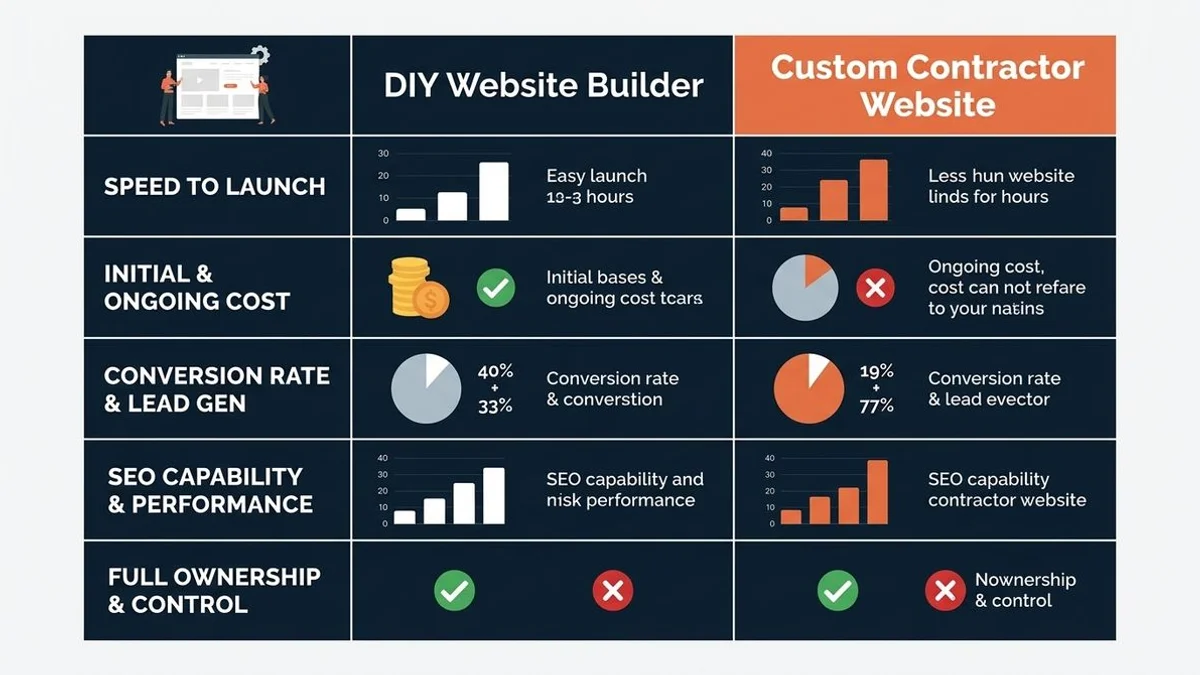
DIY website builders and custom contractor setups serve very different stages of business growth. You need to understand that drag-and-drop platforms win on upfront costs and launch speed, while custom assets generate significantly higher conversion rates and superior local SEO rankings.
Wix, Squarespace, GoDaddy, and Weebly offer great starting points, but they behave differently than a purpose-built digital asset. We see many new business owners struggle to choose between the two. The right decision depends entirely on your current cash flow and immediate revenue goals.
Let’s compare exactly where each option holds a distinct advantage.
Speed to Launch
Drag-and-drop platforms take the prize for quick turnarounds. You can realistically build a basic squarespace contractor site in a single weekend if your photos and text are ready.
We often recommend this route if you need a web presence live by Friday to catch immediate referral traffic. Custom builds generally require two to eight weeks depending on the complexity of the project.
Up-Front Cost
Starter platforms easily win the initial budget category. Most DIY builders run between $19 and $34 per month in 2026 for a premium business plan that includes hosting.
A custom contractor website starts at around $1,500 for a one-time setup fee, plus optional ongoing hosting. We tell zero-budget, brand-new startups that the cheaper route is a perfectly acceptable starting point to get their name out there.
Conversion Rate
Custom setups take the lead by a wide margin. The biggest conversion lever for any local service provider is a phone-first layout featuring prominent click-to-call buttons and highly visible trust signals.
We know that generic templates rarely implement these home service conversion patterns effectively because they cater to general businesses. Professional setups typically convert 30 to 50 percent better on the exact same amount of traffic.
SEO Ceiling
Professional builds win the local visibility fight. Starter platforms enforce hard technical SEO limits, including restricted schema markup and rigid URL structures.
We constantly see standard template sites capping out around Map Pack positions four through eight in competitive US markets. Professional builds push into the top three spots because they allow for precise technical tuning.
Long-Term Cost
The financial advantage shifts to custom builds after year two. Paying $35 a month for five years equals $2,100 in hosting alone, not counting the countless hours you spend managing updates and formatting issues.
We prefer the total cost of ownership model for established service providers. A $3,500 one-time investment with an optional $200 monthly maintenance package yields a far better return for a company generating real revenue.
At a Glance: DIY vs. Custom Metrics
| Feature | DIY Website Builders | Custom Contractor Sites |
|---|---|---|
| Typical 2026 Pricing | $19 to $34 per month | $1,500+ (One-time) |
| Average Launch Time | 2 to 3 Days | 2 to 8 Weeks |
| Phone Lead Conversion | Average (Requires hunting) | High (46% industry average) |
| Local SEO Potential | Low Competition Markets | Highly Competitive Markets |
Why Custom Sites Convert Better
Custom options convert 30 to 50 percent better because they prioritize click-to-call architecture, specialized trust signals, and lightning-fast mobile load times.
The performance gap between a basic template and a specialized layout comes down to removing user friction. We track how visitors interact with local service pages every single day across the country.
The data proves that eliminating even the smallest hurdle drastically increases your inbound lead flow. Here are the three main reasons custom designs win the conversion battle.
1. Phone-First Design
Professional layouts place click-to-call buttons in four to six prominent positions per single page. You will easily find them in the header, the hero section, a sticky mobile bar, mid-content calls to action, and the footer.
We see generic templates using only a single phone number that is often buried below the mobile fold. The conversion math is unforgiving because every visitor who has to hunt for your contact info costs you a qualified call.
2. Real Conversion Architecture
Strategic service pages handle client objections before the customer even picks up the phone. Specialized designs incorporate deep FAQ sections, perfectly positioned reviews, and simplified contact forms.
We build these sites to include rich-result eligibility using specific LocalBusiness schema markup. Drag-and-drop templates offer generic versions of these features, while custom projects optimize each element to compound your lead generation.
3. Mobile Performance
Mobile rendering speed dictates your entire bounce rate. Custom Next.js or Astro builds routinely hit scores of 90 or above on Google PageSpeed Insights, ensuring instant interaction.
We watch basic DIY builds consistently struggle, often landing in the 40 to 70 range due to heavy background code. A 2026 web performance study shows that 53 percent of mobile visitors will abandon a site that takes longer than three seconds to load.
You simply cannot afford to lose half your traffic to a slow template.
SEO Ceiling: Where DIY Hits the Wall
Drag-and-drop platforms limit your organic rankings due to bloated template code, restricted schema markup, and sluggish mobile rendering speeds.
Platforms like Wix and Squarespace have certainly improved their basic search engine features over the past few years. We still find that they cap out at being just acceptable for low-competition areas.
A basic template works fine if you are a niche trade with few local competitors in a rural-adjacent town. The technical limits become painfully obvious when you try to rank in a highly populated US market.
If you are weighing a wix vs custom website contractor setup, the data shows that the Google Map Pack is more competitive than ever. Recent 2026 local search data reveals that updated AI Local Packs feature 67 percent fewer unique businesses than the old standard map packs.
We know that claiming one of those remaining top spots requires flawless technical execution. Here is exactly where starter templates fall short:
- Template Overhead: Basic builders carry heavy background code that makes mobile load times two to four times slower than specialized Next.js or Astro frameworks.
- Schema Restrictions: Essential LocalBusiness schema is strictly controlled by the template provider rather than fully customized for your specific trade.
- Rigid Architecture: Creating clean, hierarchy-driven URLs often requires messy workarounds on starter platforms.
- Granular Speed Controls: Professional setups allow for precise caching and image optimization tools that basic builders completely block.
- Internal Linking: Automated linking patterns restrict your ability to manually build deep topical authority architecture.
In a fierce Map Pack fight for a high-volume keyword like “plumber Denver”, the technical ceiling of a DIY site is real, visible, and costly.
When DIY Is the Right Choice
A basic drag-and-drop site is the correct choice if you are a brand-new startup with zero budget or operate in a single-town market with no digital competition.
Not every local service company needs a high-end digital asset on day one. We regularly advise certain business owners to start with a cheaper option just to get their foot in the door.
A basic, functional layout is vastly superior to having no web presence at all.
Very Early Stage Companies
A brand-new service provider with zero revenue should focus entirely on generating initial cash flow. You can use a basic builder as a digital placeholder while you figure out your core business operations.
We suggest running this temporary setup for six to twelve months. You can confidently upgrade your digital presence once you have a steady stream of jobs and a clear marketing budget.
Single-Town, Low-Competition Markets
Some regions simply do not require complex search engine strategies to win local attention. A basic platform can secure decent rankings if you only compete against two or three weak local companies.
We recognize that if you do not strictly need the number one Map Pack spot to survive, a basic setup is often good enough.
Extremely Tight Budgets
Financial reality dictates many early business decisions for contractors. If a $1,500 investment for a custom starter package is genuinely out of reach, a cheap builder is your best alternative.
We want you to get your basic contact information and service list online as quickly as possible. For everyone else with real revenue trying to compete in a meaningful market, a custom build is completely worth the investment.
The Transition Path
Start with a basic builder if capital is tight, focus on hitting the $250,000 revenue mark, and then upgrade to a custom site to scale your operations.
The lifecycle of a service business usually follows a very predictable digital path. Understanding the diy website vs custom contractor website timeline is crucial for long-term growth.
We encourage owners to skip the starter platform entirely if they have the initial capital, but starting small is a perfectly valid strategy. Get your truck on the road and focus on reaching $250K to $500K in annual revenue first.
Once you hit that revenue milestone, your digital strategy needs to mature rapidly. Reinvest into a custom contractor website that ranks reliably and converts phone calls.
We construct these digital assets to act as the permanent foundation for your expanding business. You can then comfortably build a comprehensive marketing layer, like paid ads and advanced SEO, on top of a site that actually captures leads.
Want to scope a custom build and see the exact numbers? Book a strategy call with our team today.