
Our founder, Gary Magill, spent 15 years as a diesel mechanic before starting HighPoint Digital.
He knows exactly how frustrating it is to watch capable shops get buried online by inferior competitors.
That dividing line applies here: a complete digital profile separates standard results from truly great traffic.
Visibility is the name of the game.
We have seen that smart Google Business Profile optimization controls Map Pack ranking almost entirely.
Solid auto repair marketing practices build website signals for organic rankings further down the page.
The Map Pack itself responds to highly specific, localized factors.
Let’s look at the data driving these local results and explore a few practical ways to respond.
Why Auto Shops Live and Die by the Map Pack
For consumer auto repair, the auto shop map pack is the single most valuable real estate on Google because it captures the highest volume of ready-to-buy drivers. Searches like “auto repair near me”, “mechanic [city]”, and “oil change [city]” surface the top three local shops immediately.
These three shops get the vast majority of clicks and calls. The shops below the pack compete for the scraps.
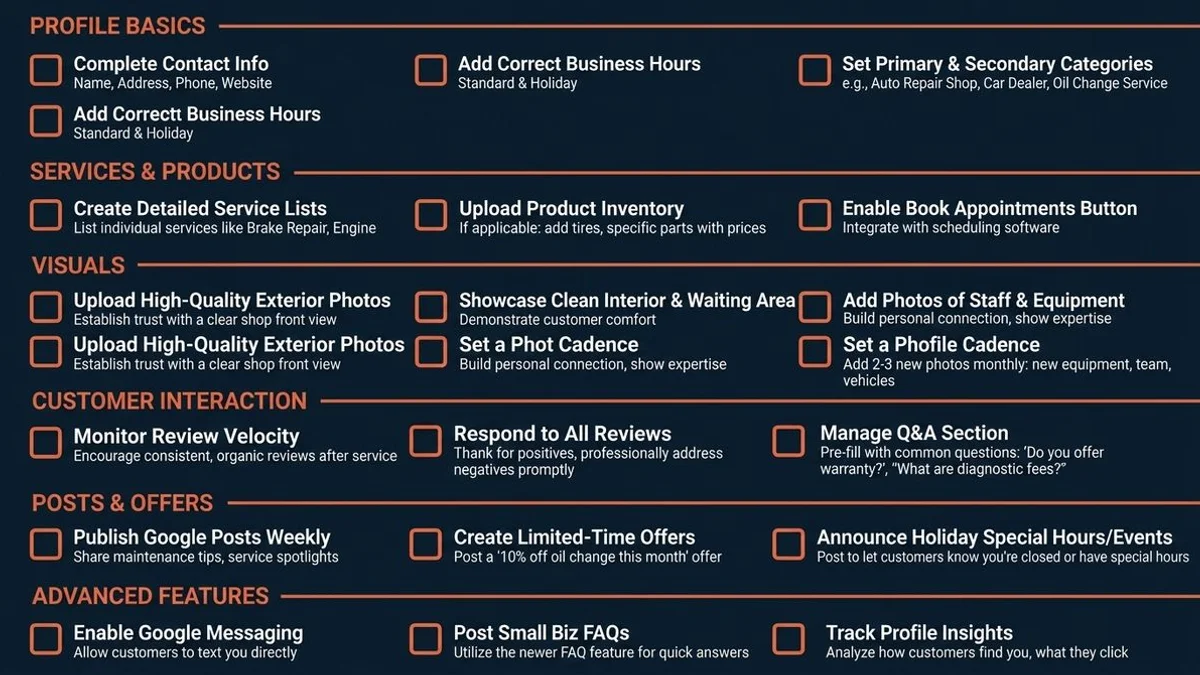
A 2026 Click-Through Rate Report from First Page Sage proves just how steep this drop-off really is.
Businesses inside the Google 3-pack capture 126% more traffic and 93% more conversion-oriented actions than those in positions four through ten.
We consistently notice that AI Overviews are now eating up search space above the Map Pack.
This shift makes claiming one of those three local spots even more critical for survival. Visibility inside the pack is effectively binary.
You either get in, or you miss out.
Primary Category: The Single Biggest Lever
Choosing your primary category correctly is the most important step because Google uses it as the foundational filter for matching searches to shops. Auto repair businesses have multiple eligible options depending on their specific service mix.
According to the 2026 Whitespark Local Search Ranking Factors report, your primary category is the single strongest ranking signal you control. You must pick one primary option that matches your highest-revenue keyword.
We recommend adding two to four secondary categories for adjacent services. Stuffing every possible category will dilute your ranking power.
| Business Focus | Recommended Primary Category | Best Use Case |
|---|---|---|
| General Consumer Repair | Auto repair shop | Standard mechanic services and diagnostics. |
| Heavy Duty / Diesel | Diesel engine repair service | Shops where diesel is the dominant work. |
| Lube & Oil | Oil change service | Narrow specialties focusing strictly on fluids. |
| Collision | Auto body shop | Dent repair, painting, and collision recovery. |
| Tires | Tire shop | Tire sales, mounting, and balancing specialties. |
This clear categorization tells Google exactly what types of customers to send your way.
Complete Services List
Building out a complete services list captures long-tail searches that competitors often miss. Google Business Profile allows up to 50 services, yet most auto shops only list three to five.
Each missing service is a missed opportunity for a local map search. Data from Clicks Geek shows over 60,500 monthly searches in the US for auto repair shops, meaning you need a comprehensive list to capture your share of that volume.
Expanding Your Standard Offerings
Start by selecting the pre-defined services Google suggests for your category. Standard items include oil changes, brake repair, engine diagnostics, transmission repair, and alignment.
You should also add cooling system service, electrical system repair, and computer diagnostics using OBD-II.
Adding Custom Specialties
We always tell our clients to add make-specific or highly specialized services as custom entries. Custom services help you stand out for niche searches.
- Diesel Specialties: Cummins service, Powerstroke service, or Duramax repair.
- Inspections: Pre-purchase inspections or US DOT inspections for commercial fleets.
- Climate Control: Specialized A/C repair and refrigerant recharging.
- Warning Lights: Specific check engine light diagnosis and reset.
Filling out this section completely ensures your profile matches a wider variety of customer emergencies.
Photo Strategy
Maintaining a consistent photo upload cadence is a strong recency signal that tells Google your shop is active. Auto shops should target a baseline of 50 photos to establish initial credibility.
A profile with 80 or more authentic shop photos converts at a 30% to 50% higher rate than a profile relying on five stock images. Customers want to see exactly where they are leaving their vehicle.
We find that authenticity easily beats polished marketing material, meaning phone-camera quality works perfectly fine for these updates. Try to upload two to five fresh photos every week, focusing on these specific categories:
- The Facility: Bays, heavy equipment, and exterior building shots.
- The People: Team photos and mechanics actively working in the bay.
- The Results: Completed work and complex repairs.
- The Proof: Before and after shots for visible work like engine bay cleanups, body repairs, or brake jobs.
Regular uploads prove to search engines that your business is open, busy, and engaged with the community.
Review Velocity
Earning a steady stream of reviews is the second-largest Map Pack ranking signal after category accuracy. The mechanism that wins here is consistent velocity rather than a massive total count from five years ago.
You should aim for at least four to eight fresh reviews per month. A 2026 AAA survey shows 66% of US drivers do not trust auto repair shops, often fearing unnecessary services.
Recent, detailed reviews are the best way to overcome that initial skepticism.
The Power of Automated Requests
We emphasize automated review requests because they are highly effective. Setting up an automated text or email request immediately after a booked job gets real results.
Auto-repair customers respond at 40% to 60% rates when asked immediately after work completion. Manual requests only land at a 10% to 20% success rate.
Review Content and Keywords
The actual text inside the review matters significantly. Reviews mentioning specific services like a “brake job” or a “transmission flush” help with keyword-specific ranking.
Customers mentioning specific timing, such as “same-day repair,” provide incredible social proof.
A recent KUKUI study found that 45% of auto shops did not respond to a single one of their last 10 Google Reviews. Responding to every review sets you apart from nearly half of your competitors.
ASE and OBD-II Signals
Showcasing Automotive Service Excellence (ASE) certification is the gold-standard authority signal in consumer auto repair. This credential does not directly change the map algorithm, but it significantly boosts consumer trust signals.
A 2026 AAA survey found that unnecessary repairs are the top fear for 76% of drivers. Customers who see ASE certifications feel safer, convert at higher rates, and leave more detailed reviews.
Maximizing Your Technical Trust Signals
We strongly advise listing your specific credentials across your entire digital footprint. You can feature these signals in a few key places:
- Website Headers: Display the ASE logo prominently near the top of your homepage.
- Google Posts: Reference specific certifications, like Master Tech credentials, in your weekly updates.
- Service Pages: Mention OBD-II diagnostic capability by name on all diagnostic service pages.
Fleet buyers and educated consumers actively search for terms like OBD-II when they need accurate computer diagnostics. Highlighting these capabilities turns technical jargon into a powerful conversion tool.
Weekly GBP Posts
Publishing a Google Post every week keeps your profile fresh and highly visible to local searchers. This steady cadence proves your business is active and ready to take on new jobs.
A weekly update gives you a chance to highlight specific offers or share recent shop success stories.
We use a mix of different post styles to keep the content engaging. Variety ensures that potential customers see different aspects of your expertise.
- Service Features: “This week we are highlighting brake service. Get a free brake check with any service over $100.”
- Seasonal Updates: “Pre-winter inspections are here. Let us check your battery, antifreeze, and tires before the first snow hits.”
- Trust Signals: “We are now an ASE-certified Master Technician shop. Three of our mechanics hold Master Tech credentials.”
- Customer Stories: “Just finished a 6.7 Powerstroke EGR cleaning for a local fleet customer. The truck is running like new.”
Maintaining this weekly cadence keeps the profile perfectly optimized in Google’s eyes. This consistency tells local drivers your bays are open and active.
Our GBP service handles this exact weekly cadence for busy auto shops.
Ready to win the Map Pack and start dominating your local market?
We know exactly what it takes to get your auto repair shop google maps profile ranking at the top.
A structured plan puts your business right in front of local drivers.
Book a strategy call today to claim your share of local search traffic.