

You know how frustrating it is to watch an inferior competitor dominate the local search results while your phone stays quiet. We see this constantly. At HighPoint Digital, Gary Magill started this company after 15 years as a diesel mechanic because he was tired of good contractors getting buried online.
From what I have seen, the biggest disconnect is always the timeline. Contractors want the phone to ring tomorrow, but Google requires proof you are a real business first.
Let’s look at the data on how long this actually takes and walk through exactly what you should expect from a real SEO partner month by month.
Month 1: Foundation
The first 30 days are foundation work, and most of it is invisible from the outside. We audit your existing site for technical issues, fix what’s broken, set up Google Search Console and analytics if they’re missing, and claim and optimize the Google Business Profile if it hasn’t been done correctly. This phase also includes installing call tracking on every channel and beginning citation building across local and trade directories.
By the end of month 1, the rank map starts to populate baseline positions. Don’t expect ranking jumps yet. Foundation work is plumbing. You can’t see it in the daily call count, but everything downstream depends on it being correct.
Our team relies on specific tools to make this happen without disrupting your existing data.
- CallRail Tracking: This dynamic number insertion software tracks exactly which marketing channel a call came from without messing up your local NAP (Name, Address, Phone) consistency.
- Video Verification: Google Business Profile verification in 2026 often requires a live video walkthrough of your shop or truck. Dalton Luka’s 2026 verification guide notes this manual review process frequently takes three to five business days to clear.
- Search Console Indexing: Safari Digital reports that the average crawl time for new web pages in 2026 is anywhere from three days to four weeks.
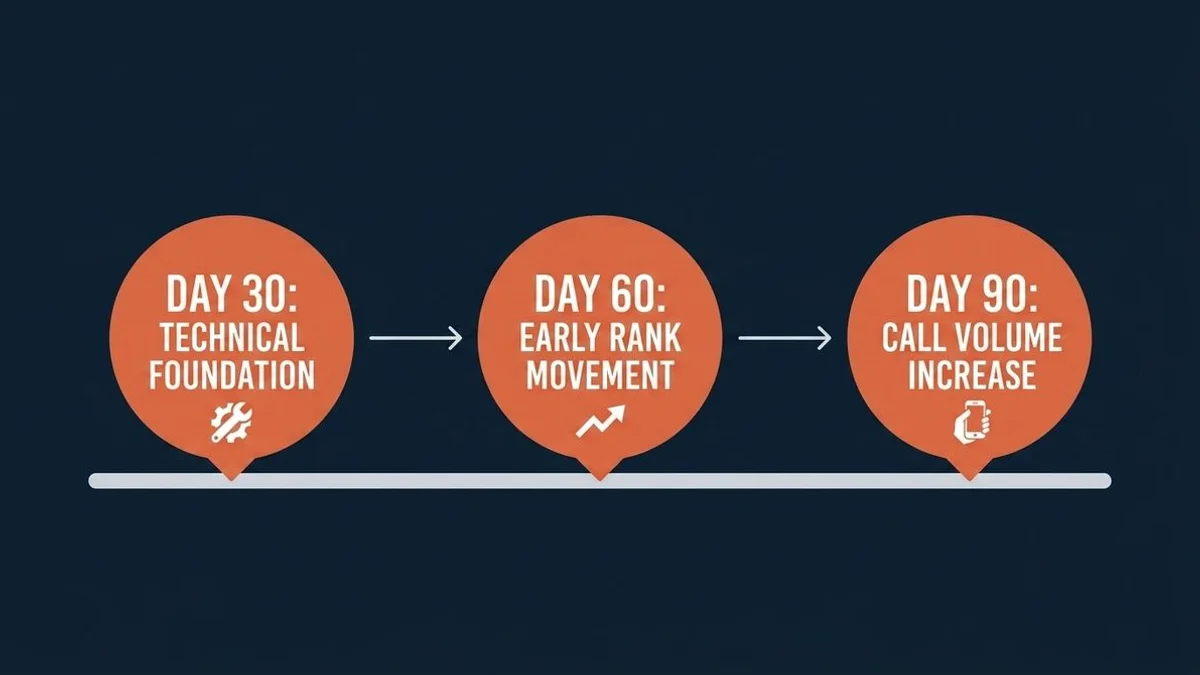
Months 2-3: First Ranking Movement
Days 60-90 are when the rank map starts moving. On-page optimization compounds with citation building and GBP improvements. Buyer-intent keywords like “emergency plumber [city]” and “AC repair near me” begin lifting positions. The Map Pack starts to show your business in nearby zip codes even if not yet in your primary one.
This is also when the early signal of changing call volume appears. It is small but measurable. You will start to see a few extra GBP calls per week and the occasional booked job that says “found you on Google” instead of “my neighbor told me about you.”
We use block-by-block geo-grid tools like Local Falcon to visualize this exact movement. Ranking in the top three spots is critical because a 2026 report on Maps SEO confirms those top Map Pack positions capture 126% more traffic than spots four through ten.
Don’t chase the monthly call count just yet. Track the weekly rank map instead. That is your leading indicator.
Expected Progress by Month 3
| Metric | Month 1 Baseline | Month 3 Expectation |
|---|---|---|
| Map Pack Position | Unranked or bottom of page | Moving up in secondary zip codes |
| Call Volume | Existing referrals only | Slight uptick in direct Google calls |
| Review Velocity | Setting up automated systems | Consistent weekly additions |
Months 4-6: Meaningful Call Volume Shift
By month 4-6, the work compounds into measurable booked-job lift. Map Pack positions stabilize in the top 3 for primary keywords. Organic rankings consolidate. Citation density is built out. Reviews are accumulating from automated request systems installed in month 1.
Most clients see a +50% to +200% call volume shift over baseline by month 6. This variance depends on a few key factors:
- Trade Demand: Roofers in storm-prone markets and water-damage shops with 24/7 attributes tend to lift faster.
- Market Competition: Contractors competing against well-established Front Range competitors may take the full 6 months.
- Previous Marketing: The worse your old marketing performed, the more dramatic the baseline shift will feel.
Our best campaigns lean heavily on steady review velocity during this phase. A 2026 local ranking study from Digital Applied shows that a steady flow of two to three new reviews per week over 90 days ranks much better than a sudden burst of 50 reviews followed by silence.
You must prepare your dispatch team for this shift. Industry data shows that 35% of home service leads are lost due to slow response times. A top-ranking profile will not save you if the phone rings out to voicemail.
What’s Happening During the “Quiet” Early Months
The biggest mistake contractors make is canceling SEO at month 2 because they don’t see immediate results. Foundation work doesn’t produce calls. It sets up the system that produces calls. Citation building takes 4-6 weeks for the directories to update. On-page changes take 3-6 weeks for Google to recrawl and recalculate rankings. GBP review velocity needs 60+ days to show up as a Map Pack ranking signal.
If you cancel at month 2, you pay for foundation work and never collect the call volume. If you stick through month 4-6, the math works.
We watch citation directories like Angi and Yelp very closely to monitor this delay. BrightLocal data confirms it takes four to six weeks just for these directories to publish your listings and for Google to index them.
Patience is the hardest part of digital marketing. The biggest mistake contractors make is canceling SEO at month 2 because they don’t see immediate results. You pay for the foundation and never collect the call volume.
A massive Ahrefs study provides even more context for this waiting period. They found that only 1.74% of newly published pages rank in the top 10 within their first year. The average number one ranking page is five years old. You are competing against established history, and overtaking it requires consistent, verifiable signals over time.
The 90-Day Accountability Test
We run month-to-month for exactly this reason. By month 3, weekly rank maps should show movement.
If they are flat, something is wrong. Either the agency isn’t doing the work, the work is wrong, or the market is too competitive for the budget.
Whatever the reason, you should cancel by month 3 if there is no measurable progress. Focus Digital’s 2026 churn report shows the first 90 days represent the peak cancellation risk across all agency models. Backlinko also notes that 65% of small businesses have bounced between two or more SEO providers.
Contractors are tired of getting burned. Real contractor SEO is accountable on a 90-day cadence. The rank map is the proof.
Want to see real rank-map progressions from named Colorado contractors? Book a strategy call today to see the exact timeline for your market.