
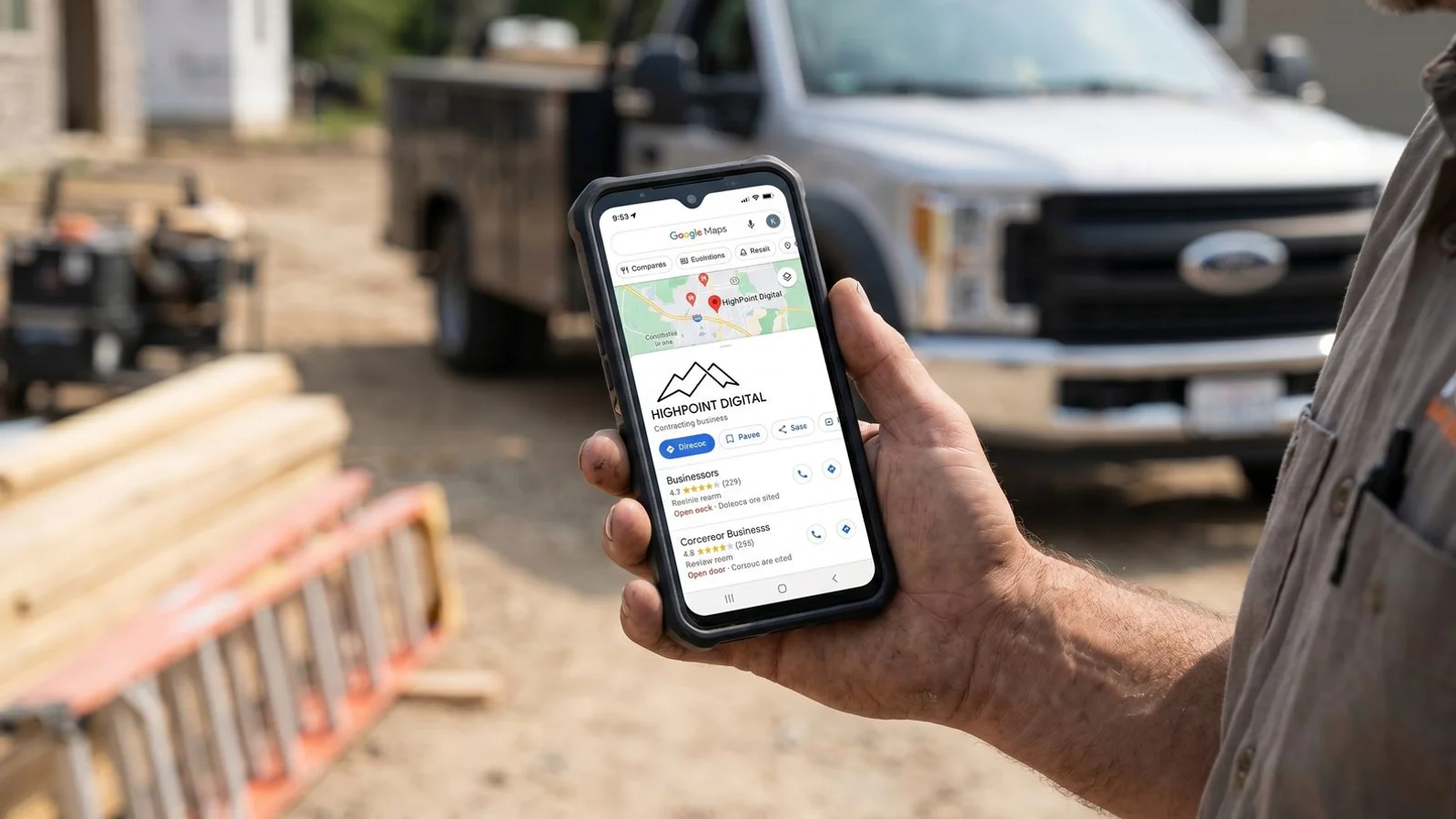
Our founder, Gary Magill, spent 15 years as a diesel mechanic before starting HighPoint Digital. He got tired of watching good contractors get buried online by inferior competitors. Today, securing a top ranking in local search results is the dividing line between thriving businesses and struggling ones.
We see a lot of confusion regarding how long to rank in google map pack results. The algorithm changes constantly, making old strategies completely useless. A 2026 study from Whitespark confirms that Google Business Profile signals now account for 32% of your local ranking weight.
- Clear timeframes for visible movement
- Specific signals that trigger growth
- Practical ways to accelerate your results
Our team focuses entirely on the data that actually drives phone calls. Knowing what signals matter saves you months of wasted effort. Let’s look at a realistic map pack ranking timeline and explore a few practical ways to respond.
The Realistic Timeline
Our timeline for a fully optimized Google Business Profile usually shows noticeable ranking improvements within 30 to 90 days. Map Pack ranking timelines look a lot like full-website SEO timelines. The difference is that local listings respond much faster to optimization signals than the broader organic algorithm.
We break this google maps ranking timeline into four distinct phases. Each phase requires specific actions to build trust with the search engine. Consistency is the most critical factor during these early months.
Days 1-30: Foundation
Our initial focus is always on securing your digital foundation. Profile cleanup, category accuracy, services list completeness, and photo backlog uploads happen right away.
Video verification is the default requirement for new listings in the US in 2026.
We prioritize setting the most precise primary category possible. Whitespark data gives category selection a massive influence score of 193.
By day 30, visible ranking changes might just be moving from outside the top 20 to the 8-12 range.
Days 30-60: Signal Buildup
Our strategy shifts to sending strong engagement signals once the profile is active. This involves a steady photo cadence of two to five uploads weekly and regular Google Posts.
Automated review requests go out immediately after every booked job.
We start seeing the first real map pack movement around the two-month mark. Fresh signals are stacking rapidly at this point.
Google finally recognizes an active, well-maintained profile.
Days 60-90: First Map Pack Movement
Our clients typically see their primary keywords lift into the top three to five positions. These early wins usually apply to searches originating very close to the business address.
Adjacent service-area terms also begin gaining traction.
We also notice long-tail buyer-intent keywords appearing in local results for the first time. An example would be a phrase like “emergency plumber near me.”
Tracking tools like BrightLocal grids will confirm this hyper-local visibility.
Days 90-180: Sustained Lift
Our final phase cements those top positions across a wider geographic area. Primary service-area rankings stabilize.
Review velocity continues to compound.
We consider month six the point where the profile produces sustained call volume. This call volume stays measurably higher than the original baseline.
Consistent photo updates help maintain this momentum indefinitely.
The Role of Review Velocity
Our data shows that review velocity, the rate of new reviews per month, matters far more than your total review count. Aim for at least two to four fresh reviews every single month.
There is no magic total number that guarantees top rankings.
We constantly see profiles with 80 recent reviews outranking competitors holding 200 stale reviews from two years ago. The Whitespark 2026 report proves that review signals command 20% of the total local ranking weight.
Recency metrics completely dominate historical totals.
| Strategy | Average Monthly Reviews | Ranking Impact |
|---|---|---|
| Manual Requests | 0-1 | Low visibility, stale signals |
| Automated SMS/Email | 4-8 | High visibility, strong momentum |
Our primary mechanism for maintaining this velocity is strict automation. Every booked job should trigger an automatic request via text or email within 24 hours.
Contractors without automated systems usually gather zero to one organic reviews monthly.
We typically see four to eight reviews per month after implementing a system. The onboarding process for Our GBP optimization service installs this exact review-request automation.
Platforms like BusinessRate now evaluate your reputation based heavily on the last 90 days of activity.
Citations and Consistency
We build citations across 30 to 50 local directories to firmly anchor your business data in the local search graph. Citations are mentions of your business name, address, and phone number (NAP) across the web.
They move slowly but provide durable authority.
Our research indicates a clean citation profile carries about 7% of traditional ranking weight in 2026. This foundation is also crucial for the new AI search features.
Citations represent three of the top five ranking factors for AI search visibility today.
We focus heavily on top US aggregators like Data Axle and Neustar Localeze. Inconsistent information across these platforms confuses Google and degrades rankings.
A business with three different addresses or an outdated phone number will drop in visibility.
- Mismatched suite numbers or street abbreviations
- Old phone numbers from previous marketing campaigns
- Slight variations in the official business name
- Missing profiles on primary data aggregators
Our 30-day foundation work always includes comprehensive citation cleanup. Abbreviations must match your Google Business Profile exactly.
Correcting these mismatches restores lost algorithm trust quickly.
Why Proximity Isn’t Everything
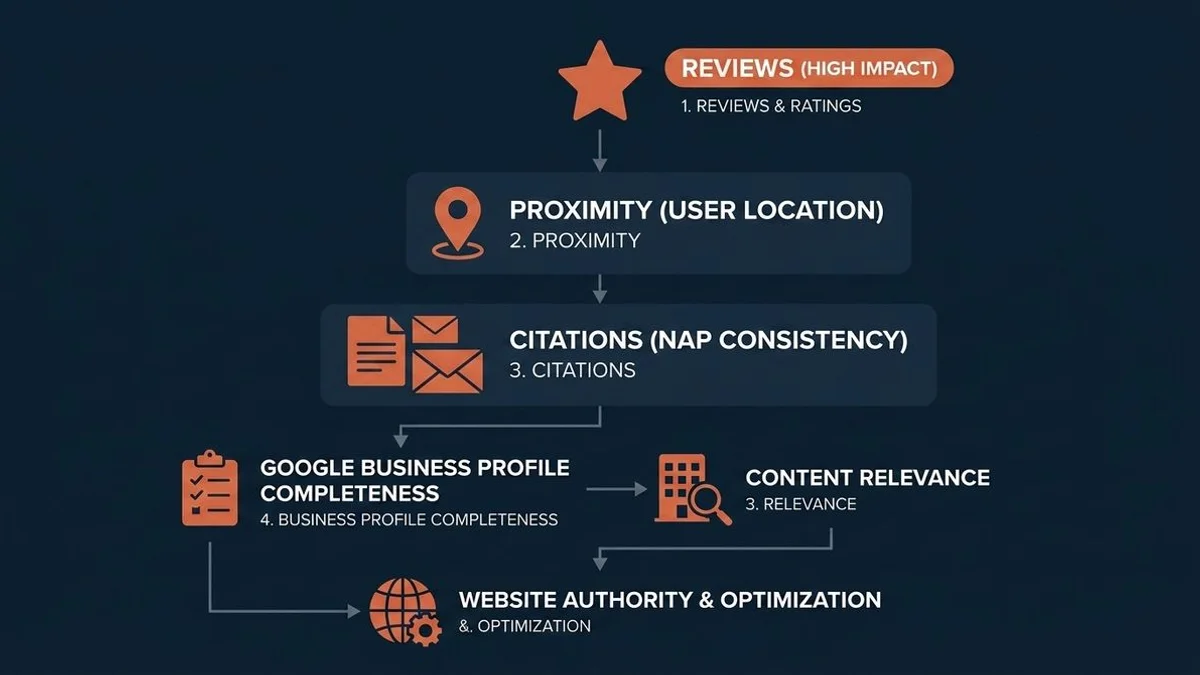
We consistently see well-optimized profiles outrank closer competitors because Google values relevance and prominence over sheer distance. Proximity is the physical distance between the searcher and your business address.
It is a real ranking factor, which explains why “near me” searches favor local options.
Our experience proves that proximity alone does not override stronger profile signals. You can beat a neglected listing one mile away if your profile sits three miles away but carries higher authority.
Google evaluates listings using three main pillars, which are relevance, prominence, and proximity.
We cannot control a searcher’s physical location.
Better category accuracy, more recent photos, and faster review velocity compound to dominate the relevance and prominence pillars. A complete services list also adds massive weight.
Our team has moved Front Range contractor profiles into the top position for searches originating four to five miles away. These optimized profiles easily beat closer but weaker competitors.
The 2026 Whitespark data confirms that an optimized profile with a hidden service area address can still dominate a poorly managed listing with a visible storefront.
What to Watch Before Rankings Move
Our early performance tracking relies entirely on leading indicators like profile views and direct customer actions. Ranking position is actually a lagging indicator during the first 30 to 60 days.
Direction requests and click-to-call actions are massive engagement signals in 2026.
We watch for specific metrics that prove the optimization work is taking hold. Increasing photo views and a higher success rate on review requests show positive momentum.
Tracking platforms like Localo help us monitor these subtle shifts before they hit the main results page.
- Rising total profile views
- Increased click-to-call actions
- More requests for driving directions
- Higher conversion rates on review requests
Our baseline expectation is that ranking improvements will follow if these engagement metrics rise. A flatline across all leading indicators at day 90 means something is fundamentally wrong.
That lack of movement represents the absolute threshold to cancel a service and find better help.
We offer a free GBP audit to identify exactly what is holding your profile back. Book a strategy call today to get started.
Your local visibility can improve dramatically with the right approach.