
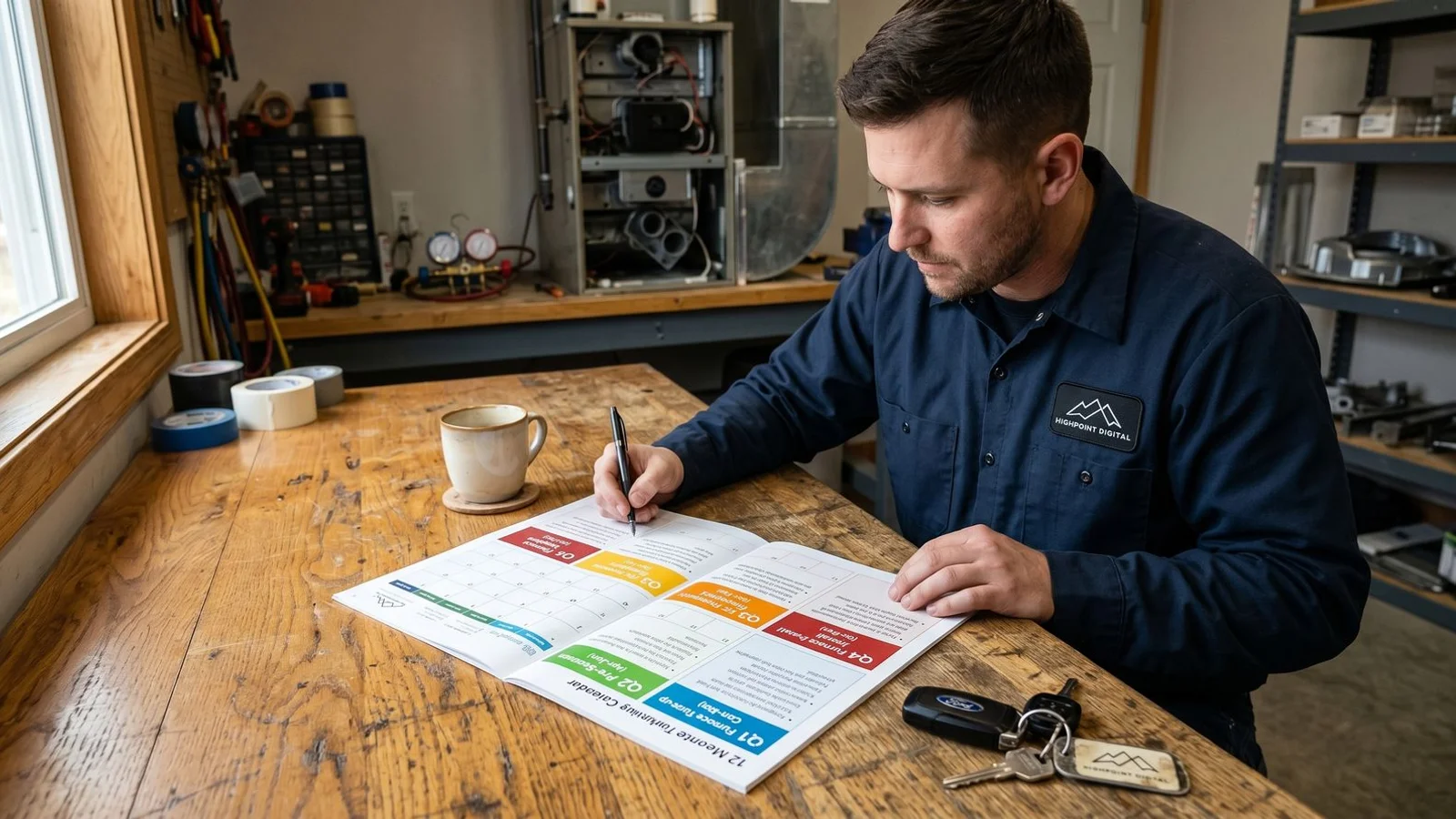
The Seasonal HVAC Calendar Problem
You know the feeling of a packed schedule in July followed by a painfully empty board in October.
The U.S. HVAC industry is projected to hit $165 billion in 2026, meaning the demand is definitely there. Our team at HighPoint Digital, founded by 15-year diesel mechanic Gary Magill, helps local business owners fix this exact feast-or-famine cycle through targeted seasonal HVAC marketing.
This data reveals exactly why those seasonal dips happen. We will outline a practical 12-month schedule to keep your dispatch board full.

Spring AC Tune-Up Campaigns (March-April)
Spring AC tune-up campaigns secure early revenue by targeting homeowners who want to beat the summer service backlog. Booking these jobs in March and April prevents your technicians from sitting idle before the heat waves hit.
Based on 2026 data from Housecall Pro, repair revenue share has climbed to 33.4% of total HVAC revenue. Getting your foot in the door early for a tune-up often leads to these lucrative repair jobs. WebFX search trend data shows that “AC repair” searches spike by 266% in July.
Our strategy relies on capturing that intent months in advance. A targeted pre-peak SEO push in March improves your Google Business Profile ranking right before the summer rush.
Focus on these specific elements for spring:
- Marketing Message: “Get your AC tuned up before the first heat wave.”
- Keyword Targets: “AC tune-up [city],” “spring AC maintenance,” “AC service before summer.”
- Budget Allocation: Lean heavily into spring ads because this work compounds into peak-season visibility.
- Verification Check: Ensure your Google Local Services Ads background checks are fully updated by March.
Summer Peak Emergency (June-August)
Summer marketing shifts entirely to emergency AC repair services for homeowners facing immediate breakdowns. You need to capture high-intent searches when cooling systems fail during peak heat.
According to a 2026 benchmark report from SearchLight Digital, Google Local Services Ads costs for HVAC average between $80 and $113 per lead during the summer. High-intent terms like “emergency AC repair” see conversion rates of 30% to 50%. The mistake most HVAC contractors make in this window involves cutting their marketing budget because they are already busy.
We see companies lose their Map Pack rank during peak season because their daily signals drop. Review velocity accounts for roughly 20% of the Map Pack ranking equation. Stopping your ads and review requests causes your rankings to slip.
| Marketing Channel | Average Cost Per Lead (Summer 2026) | Best Use Case |
|---|---|---|
| Google Local Services Ads | $80 - $113 | High-intent emergency calls |
| Google Ads (Non-Branded) | $149 | Capturing generic repair searches |
| Google Ads (Performance Max) | $72 | Automated, budget-friendly reach |
Shoulder-Season Indoor Air Quality (April-May, October-November)
Shoulder seasons offer the perfect window to sell indoor air quality improvements while heating and cooling demands are low. Homeowners are highly receptive to these upgrades during the spring allergy season and dry fall months.
The U.S. indoor air quality monitoring market is booming and is projected to reach over $4.3 billion by 2034. Consumer demand is obvious, with major manufacturers like Panasonic launching smart products such as the OASYS central systems that heavily feature IAQ integration. Most competitors skip this market entirely.
Our clients who run IAQ campaigns during an hvac shoulder season in April and October typically see massive results. A Front Range HVAC contractor can lift shoulder-season revenue 25% to 40% over a contractor who ignores this window, especially when content marketing leans heavily into IAQ education.
Prioritize these specific service offerings:
- Marketing Message: “Better breathing in your home, starting with a comprehensive IAQ assessment.”
- Keyword Targets: “indoor air quality [city],” “whole house air filtration,” “dehumidifier install.”
- High-Margin Upgrades: Focus on humidifier installs and advanced air scrubber technologies.
Fall Furnace Prep (September)
Fall furnace marketing must launch 60 days before peak heating demand to capture early maintenance jobs. By the first hard frost in mid-October, your campaigns should already be ranking and producing consistent leads.
Waiting until October means you compete from a cold start. WebFX 2026 data shows “heating system repair” searches experience a massive 594% volatility swing between summer lows and winter highs. You need to build momentum before that massive spike occurs.
We recommend mirroring your spring AC playbook for the fall season. The mechanics remain exactly the same, but the service changes. The U.S. Department of Energy notes that unmaintained furnaces lose efficiency rapidly.
This provides a highly effective marketing angle for budget-conscious homeowners:
- Marketing Message: “Furnace tune-up before the first cold snap.”
- Keyword Targets: “furnace tune-up [city],” “fall furnace maintenance,” “furnace inspection.”
- Urgency Factor: Remind customers that waiting for a breakdown means waiting days for a technician in December.
Winter Furnace Repair (November-February)
Winter marketing focuses strictly on same-day emergency furnace repairs to capture desperate homeowners without heat. Paid ads and Local Services Ads must run at maximum capacity during these freezing months.
Performance Max campaigns on Google currently average a highly efficient $72 cost per lead for HVAC. This makes them an excellent supplement to your primary search ads during peak heating demand.
Our agency constantly reminds contractors to answer the phone immediately during this season. Google penalizes your Local Services Ads rank for missed calls, meaning if a desperate homeowner hits your voicemail, you lose both the job and your ranking power.
“A missed call during winter isn’t just a lost job; it’s a negative signal to Google that your business is unavailable, which directly hurts your Local Services Ads ranking.”
Maintenance-Plan Marketing (Year-Round)
Implementing hvac year-round marketing through maintenance plans provides the most reliable recurring revenue for your business. Customers with active subscriptions will call you first for repairs and remain loyal for years.
Industry data shows the Customer Lifetime Value for an average HVAC customer is roughly $15,340. However, maintenance members typically boast a 2.4x to 3.1x higher lifetime value. A Front Range HVAC contractor with 500 active maintenance-plan members typically has $50,000 to $100,000 of locked-in annual recurring revenue.
Our most successful clients market these plans constantly, not just during the slow seasons. Approximately 30% to 40% of their highly profitable repair work comes directly from these existing members.
You must use dedicated landing pages with explicit plan pricing to capture leads effectively. Software platforms like ServiceTitan or Housecall Pro can automate the billing and scheduling for these agreements:
- Marketing Message: “Membership pricing on annual maintenance, priority emergency service, and a 10% discount on repairs.”
- Keyword Targets: “HVAC maintenance plan [city],” “HVAC service contract residential.”
- Sales Tactic: Train your technicians to offer the maintenance plan discount directly on the invoice during a repair call.
The Editorial Calendar Template
A structured 12-month marketing calendar dictates exactly which keywords, ads, and social posts to push during each specific season. Following this timeline keeps your dispatch board full from January through December.
Our HVAC marketing builds a customized 12-month editorial and keyword calendar mapped specifically to your trade. The calendar shows which keywords to push when, which Google Posts to publish each week, and which paid campaigns to ramp up.
We want to help you eliminate the revenue rollercoaster for good. The phone stays ringing all year long when your seasonal hvac marketing respects the calendar. Ready to map yours? Book a strategy call with our team today.