
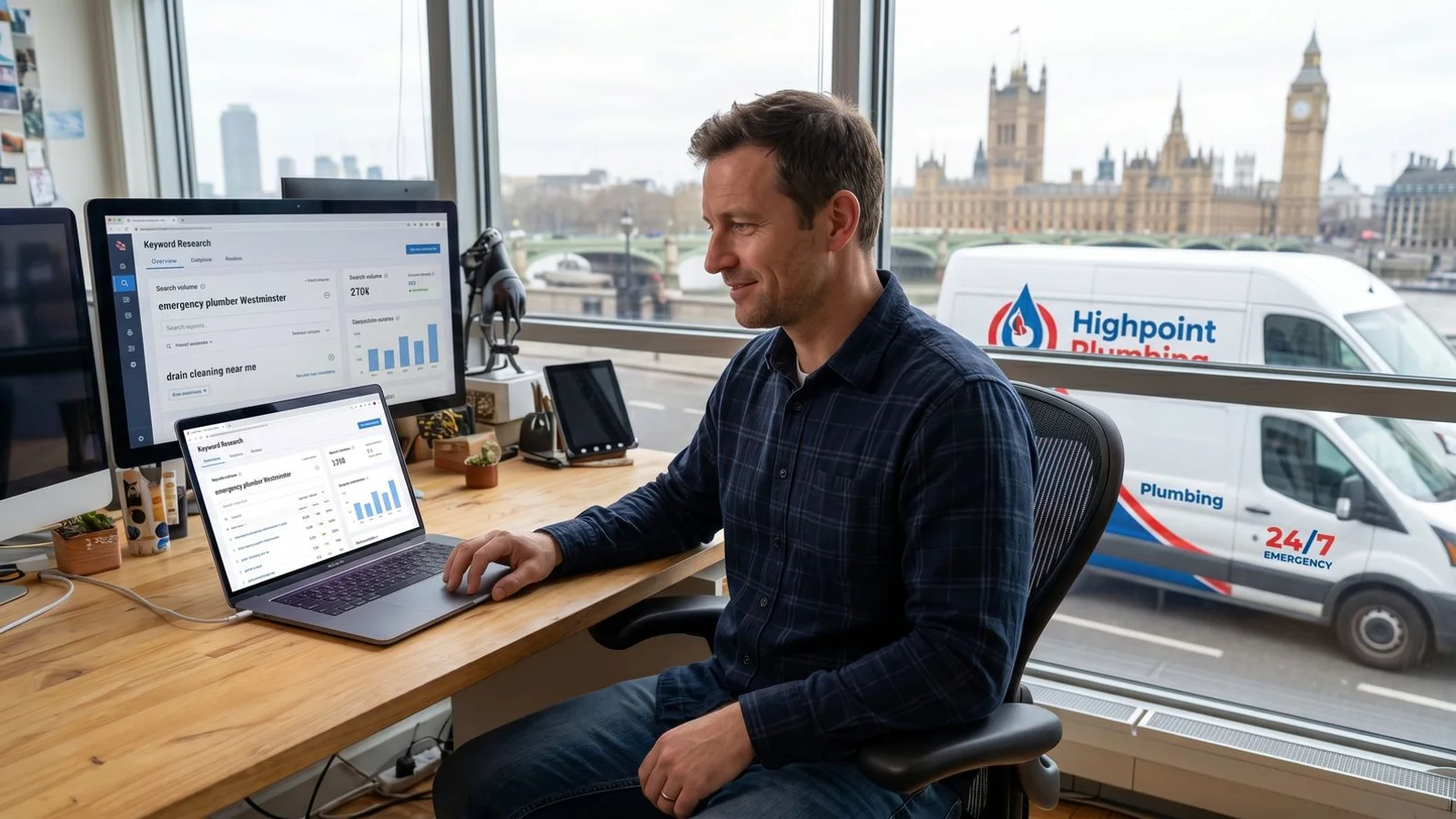
Our foundation at HighPoint Digital started when founder Gary Magill transitioned from a 15-year career as a diesel mechanic, frustrated by seeing good contractors buried online by inferior competitors.
Building a real plumbing marketing keyword strategy is the first step to fixing that exact problem.
A 2026 US market analysis shows that 72% of homeowners search online before calling a contractor. We focus heavily on these metrics because finding the right seo keywords for plumbers leads to conversion rates between 12% and 16% when urgency is involved.
Let’s look at the data, see what it actually tells us, and outline a specific plan of attack.
The Five Categories of SEO Keywords for Plumbers to Target
A successful keyword strategy targets 15 to 30 high-intent search terms across five specific categories rather than trying to rank for everything. Anything beyond that specific scope dilutes your focus and wastes resources.
We recommend avoiding a massive list of general terms because targeting local intent is far more profitable.
1. Emergency variants
Emergency terms are the highest-intent plumbing searches on the internet. People searching for phrases like “emergency plumber near me” or “after hours plumber Westminster” are actively experiencing a crisis.
Recent 2026 search volume data from Semrush shows that “emergency plumber near me” generates roughly 90,500 monthly searches in the United States. We always place these five to seven keywords at the very top of any target list.
The raw search volume might be moderate compared to generic terms, but the conversion intent is fully maxed out. Studies show that 58% of these emergency calls originate directly from a localized Google search.
2. Service-specific keywords
Each major service you provide deserves a dedicated keyword target and landing page. Examples include “water heater repair [city],” “leak detection,” and “sewer line repair.”
Search volume for a term like “water heater repair” hits about 165,000 monthly searches in the US. We advise modifying each of these core services with a specific city or neighborhood name to compound your local SEO efforts.
Aim to build out eight to twelve of these highly specific service targets.

3. Commercial plumbing keywords
Commercial plumbing targets a completely different buyer journey and requires distinct search terms. Facility managers search for “commercial plumbing services” or “restaurant plumbing repair” rather than standard residential terms.
A term like “commercial plumber near me” might only see 2,400 monthly US searches, but the average ticket size is exponentially higher. We build these commercial targets out completely separately from residential campaigns.
- Target Audience: B2B decision-makers and property managers handling multi-unit properties.
- Software Context: Use of platforms like AppFolio dictates a professional maintenance search language that differs entirely from homeowner searches.
4. Location-modified variants
You need to target every core service with a variety of city and neighborhood combinations. Search terms like “plumber Thornton” or “drain cleaning Castle Rock” capture users looking for immediate, nearby help.
Each of these location variants must become its own dedicated landing page or service-area page. We suggest aiming for 8 to 15 specific location variants across your primary service area.
Establishing a strong presence in the Google Map Pack for these exact areas is crucial for driving phone calls.
5. Long-tail buyer-intent
Specific, long-tail phrases have lower volume but produce extremely high conversion rates. Searches for “burst pipe repair near me” or “main water shut off valve repair” happen when something is actively going wrong.
The searcher is past the research phase and is ready to book a job immediately. We see tremendous value in these exact-match phrases because they face far less competition than generic terms.
Every single click on a long-tail emergency phrase represents a high probability of a booked job.
Keywords to Skip
The most common SEO mistake contractors make is targeting informational keywords simply because they show high search volume. These terms rank easily and generate website traffic, but they do not produce booked jobs.
We strongly advise ignoring do-it-yourself searchers who have zero intention of paying for professional services. A tool like Ahrefs will show massive traffic potential for informational guides, but local conversion rates on those pages are near zero. Skip the following types of phrases to keep your marketing budget focused on actual buyers.
| Keyword Example | Searcher Intent | Why You Must Skip It |
|---|---|---|
| ”How to fix a leaky faucet” | DIY searcher | Looking for free instructions, won’t pay for labor. |
| ”What is hydrostatic testing” | General researcher | Seeking definitions, not actively hiring a contractor. |
| ”How much does a plumber cost” | Price shopper | Results in a race to the bottom with low conversion rates. |
| ”Plumbing tips” | Content browser | Top-of-funnel traffic that rarely leads to a local booking. |
Commercial vs Residential Keyword Splits
Residential buyers search by the specific service they need, while commercial buyers search by the broader trade context. The keyword pools between these two audiences almost never overlap. A residential customer searches for “drain cleaning,” while a facility manager types “restaurant plumbing maintenance.”
We always run two completely separate keyword strategies if a client serves both markets. A single generic services page cannot rank effectively for both audiences because the user intent and specific language differ so drastically.
- Residential Intent: Urgent, single-decision makers focused on speed and direct pricing.
- Commercial Intent: B2B decision-makers seeking long-term maintenance contracts and code compliance.
Recent 2026 B2B data indicates that commercial clients take longer to convert but yield a massive return on investment. Our approach ensures that commercial landing pages speak directly to property managers handling large-scale contracts.
Trade-Specific Entity Coverage
Modern plumbing SEO keywords must reference real trade entities to signal genuine topical authority to search engines. Sprinkling generic terms into a paragraph is an outdated tactic from a decade ago.
Google’s Natural Language API actively looks for specific industry vocabulary to verify that an expert wrote the content. We require our writers to naturally integrate exact terminology that proves a deep understanding of the plumbing trade. These context clues help your content outrank competitors who rely on generic, outsourced copy.
- Specialized Equipment: Hydro-jetting systems, trenchless sewer repair tech, and sewer scope inspection cameras.
- Specific Components: PEX piping, tankless water heaters, sump pumps, and heavy-duty ejector pumps.
- Regulatory Standards: Exact references to backflow prevention regulations and the 2024 International Plumbing Code (IPC).
Our data shows that pages featuring these exact entities rank faster because search engines recognize the specialized vocabulary. These terms belong naturally on service pages when the writer actually understands the mechanics of the job.
The 30-Keyword Starter List
A focused, highly targeted plumber keyword list forms the foundation of any successful local search campaign. For a residential contractor in a competitive US market like the Front Range, this structured approach captures the most profitable traffic.
You can track the success of these specific terms using local grid tools like Local Falcon to monitor your exact Map Pack rankings. We use this precise framework to generate consistent, high-quality phone calls for local contractors. Here is what a target list of 25 to 30 keywords looks like:
- Emergency Targets: “Emergency plumber [primary city]” plus 3 specific emergency variants.
- Core Services: “Water heater repair [primary city]” and “Drain cleaning [primary city],” each with 3 localized variants.
- High-Value Repairs: “Sewer line repair [primary city]” and “Leak detection [primary city],” each with 2 variants.
- Adjacent Suburbs: 5 service variants targeting specific nearby towns.
- Long-Tail Intent: 5 specific buyer-intent phrases like “burst pipe” or “no hot water.”
Each phrase on this list requires a dedicated landing page or service-area page to rank properly. Our foundational work inside our plumbing marketing system builds these assets systematically.
Tracking these seo keywords for plumbers ensures your business captures local traffic at the exact moment a customer needs help.
Ready to audit your keyword strategy and see where your website stands? We offer a comprehensive strategy call to analyze your current search visibility, so book a strategy call today to get started.