
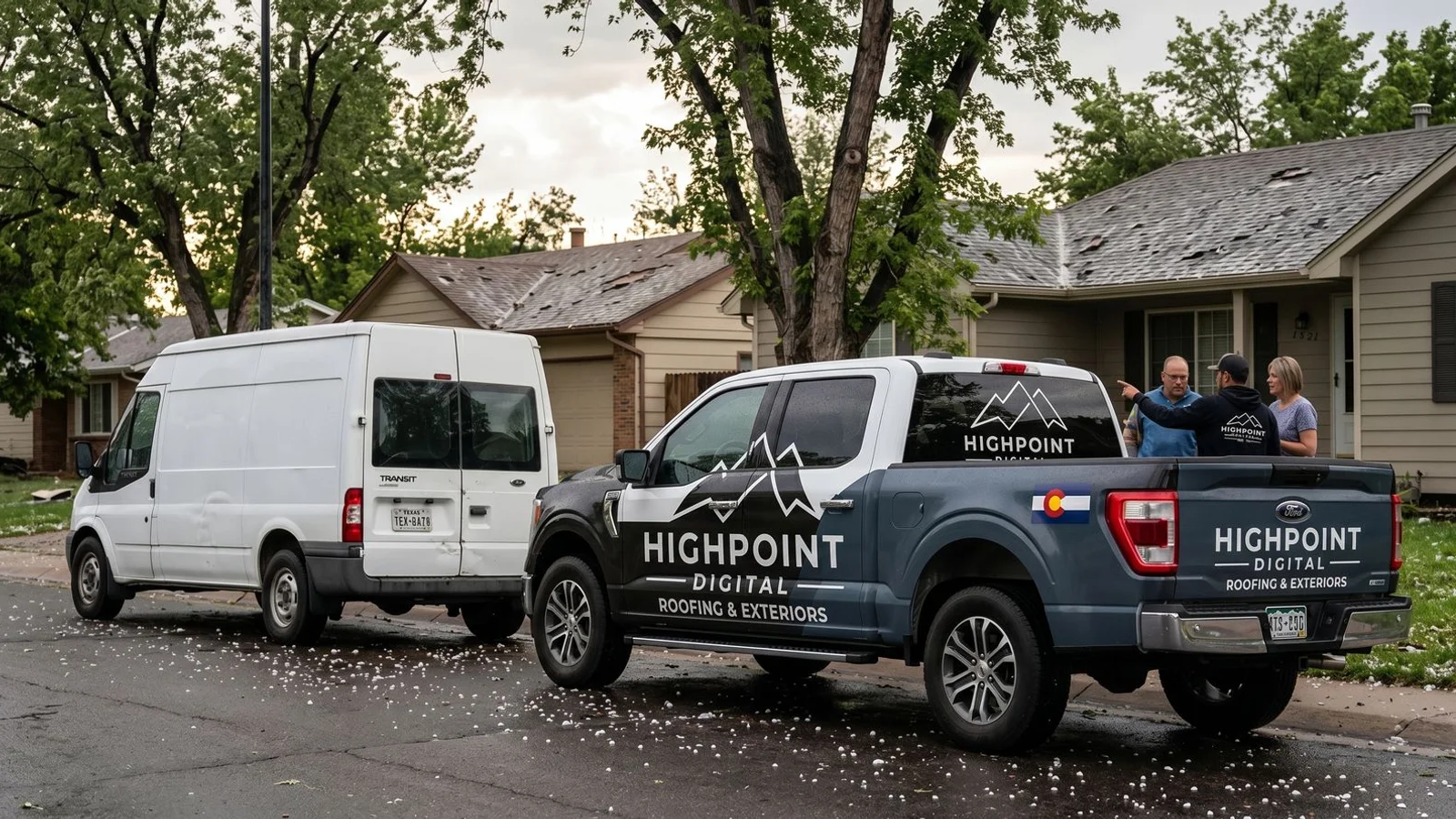
We consistently see smart contractors get buried online by inferior competitors. The foundation of a successful local roofer marketing strategy starts with understanding your specific business model. The battle of storm chaser vs local roofer marketing comes down to totally different operational timelines.
Our 15 years of experience in the diesel and contracting space prove that local authority always wins.
Let’s look at the data to understand these two distinct approaches. Then, you can apply these tactics to protect your market share.
Two Different Marketing Models: Storm Chaser vs Local Roofer Marketing
Storm chasers rely on short-term tactics like door knocking and fast ads. The core difference lies in their operational timelines and geographic commitment.
We track this marketing behavior closely across the country. The National Oceanic and Atmospheric Administration reported 7,000 severe hail events in the US last year. Those storms caused over $10 billion in property damage.
The Out-of-State Approach
Our marketing strategies must adapt to this reality. A mobile crew moves into a hard-hit zip code for 60 to 90 days. They saturate the area with paid social ads and aggressive sales pitches.
We know they avoid long-term investments like search engine optimization. These crews simply will not stay in town long enough to see a return on that cost. Local businesses live in the community year-round.
The Local Authority Approach
Our approach focuses on compounding visibility. A neighborhood company invests in sustained search authority and deep review banks. They build up their Google Business Profile and local directory citations.
We build a presence that grows stronger every single month. This steady growth eventually dominates the search results.
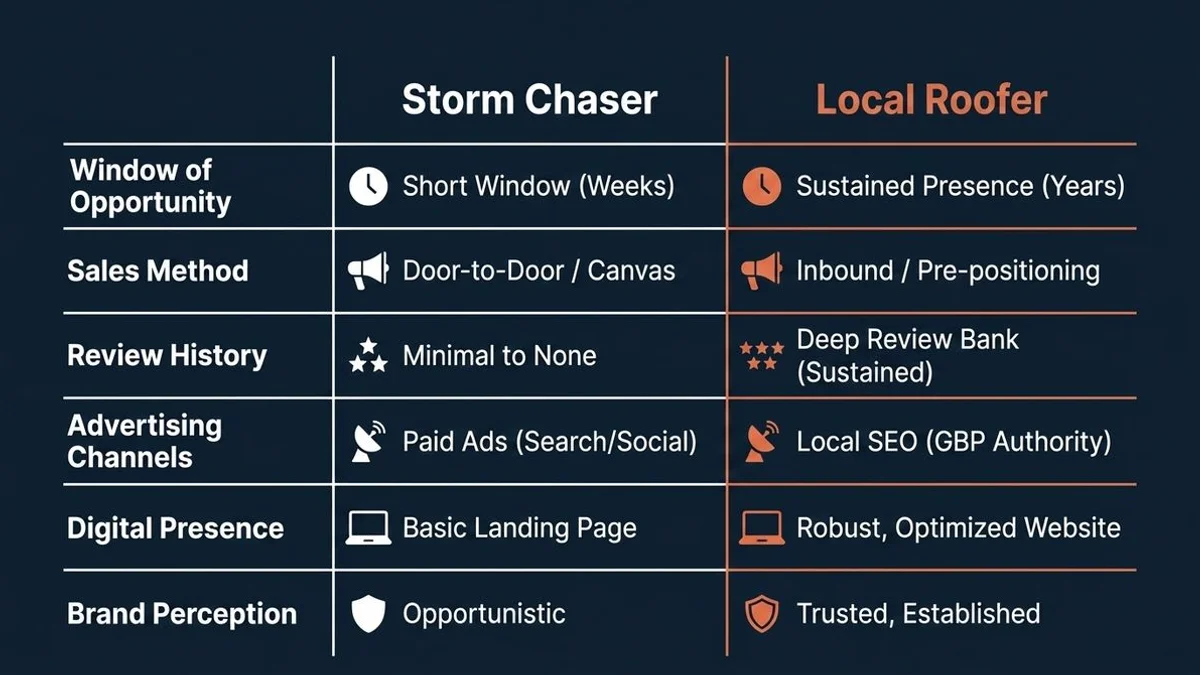
| Marketing Focus | Storm Chaser Model | Local Roofer Model |
|---|---|---|
| Timeline | 60 to 90 days per city | Year-round permanence |
| Primary Tactics | Door knocking, short-term ads | SEO, community reviews |
| Investment Strategy | High upfront ad spend | Sustained organic growth |
| End Goal | Immediate volume | Compounding local authority |
Where Each Approach Wins
Storm chasers win through sheer speed and massive sales volume right after a weather event. Local roofers win by providing authentic trust signals and superior search visibility.
We see out-of-state crews knocking on doors within hours of a hailstorm. A single crew might pitch hundreds of homeowners every single day. Their conversion rate is terrible.
Our team knows their massive volume makes up for the low closing percentage. These mobile crews often offer free inspections or make bold promises about insurance approvals. The Better Business Bureau warns that many of these operators demand massive upfront payments.
The Hidden Costs of Transient Crews
We always tell property owners to watch out for these red flags. In 2024, Texas residents reported over $200,000 in losses to home improvement scams on the BBB Scam Tracker. Scam contractors sometimes even use tools to dent shingles artificially.
Our established clients win by leaning into their hard-earned reputation. Homeowners want a company with a strong rating and local references. They want a warranty backed by a business that will actually exist in five years.
We help contractors highlight their deep understanding of the insurance claim process. Here is exactly where local companies dominate the market:
- Search Visibility: High placement in the Map Pack captures high-intent searches.
- Trust Signals: Years in business and verifiable local references build immediate confidence.
- Warranty Reliability: A long-term warranty only matters if the company stays in town.
- Insurance Expertise: Established teams manage complex claims legally.
Year-Round Content vs Storm-Window Blast
Out-of-state crews only run ads during severe weather windows because they leave town afterward. Established neighborhood contractors must publish content year-round to build search authority.
We build continuous campaigns because consistency dominates the search algorithms. A landing page spun up in a panic cannot compete with a deeply established website. The algorithms favor businesses showing steady activity.
Our data shows that content published in February will drive massive traffic by June. According to 2026 local search data, Google Business Profile signals now account for 32% of your ranking influence. The search engine wants to see weekly posts and fresh photos.
The Power of Continuous Signals
We use this exact strategy to signal an active business. Capturing customer feedback during the slow months is critical for long-term survival. Consumers rely heavily on recent feedback.
Our research indicates that 87% of consumers read online reviews before choosing a contractor. Profiles with fewer than 10 reviews face a severe conversion penalty. Fully optimized profiles generate four times more website visits than neglected ones.
We run our roofing marketing calendar for a full 12 months for this precise reason. This creates powerful year-round advantages:
- SEO Authority Compounds: Consistent publishing builds a foundation that outlasts any storm.
- Review Velocity Continues: Capturing feedback during slow months prevents your profile from looking abandoned.
- Brand Recognition: Customers see you as a permanent community fixture.
Property owners searching before a storm will recognize your established brand.
We make sure they view your company as a trusted local resource instead of just storm-day signage.
The Long-Game Economics
The storm-chaser model relies on massive short-term ad spends that completely reset to zero once they leave town. The local roofer model uses consistent annual investments to build compounding permanent value.
We always focus on the true cost per closed job instead of vanity metrics. A mobile crew might drop $50,000 during a 60-day window to generate 200 jobs. They might see $1.6 million in revenue with a 30% gross margin.
Our analysis shows this looks great on paper until they have to start over in the next state. Their marketing return on investment vanishes the second they cross the county line. A neighborhood company operates with completely different math.
The Cost of Shared Leads
We prefer the steady economics of a $30,000 to $60,000 annual marketing budget. Shared leads from cheap directories often cost $35 to $75 upfront. These shared leads close at less than 5% because multiple companies call the same person.
Our clients avoid that trap by focusing on exclusive organic leads. A 2026 industry study revealed that heavily contested shared leads can cost up to $4,800 per closed deal. This high expense completely destroys profit margins.
We help teams bring that cost down by dominating local search results.
The number that matters is the final cost per booked job. An exclusive organic lead closing at 40 percent is dramatically cheaper than a shared lead closing at 4 percent.
Local contractors generate 80 to 150 jobs a year through a mix of repairs and replacements. They build a predictable $1.8 million in annual revenue with high margins.
We love the compounding nature of this long-term investment. By year three, the marketing budget stays the same but produces up to 80% more jobs. A five-year sustained campaign can push annual revenue past $2 million with a tiny marketing ratio of 3%.
We know out-of-state crews can never match those numbers because they constantly start from scratch.
Positioning Against Storm-Chaser Pitches
When facing a storm-chaser pitch, aggressive contractors highlight their permanent local presence. Property owners need to realize that out-of-state crews will not be around to honor their massive warranty promises.
We train sales teams to counter these cheap pitches with hard facts. A homeowner will often say they got a quote from someone who knocked on their door. You must respond by outlining the specific dangers of hiring transient labor.
Our recommended playbook focuses on five undeniable advantages.
- Tenure: Point out your history in the city. The door-knocking crew just drove in from three states away.
- Licensing: Tell them to verify your specific municipal permits. Colorado does not have a statewide roofing license, so local city permits are the only real proof of legitimacy.
- Insurance Track Record: Explain how you process claims legally and ethically. Many states are passing strict laws to stop third-party contractors from hijacking claims.
- Warranty Reliability: Emphasize that your warranty is honored locally. A paper promise means nothing if the company dissolves next month.
- Local References: Provide three recent jobs in their exact zip code. Out-of-state crews cannot show local neighborhood proof.
State legislation is actively changing to protect homeowners from bad actors. Florida recently banned Assignment of Benefits agreements entirely to stop claim fraud.
We expect other states to pass similar restrictions in 2026. Ethical companies manage claims legally without relying on these controversial tactics. Storm chasers simply cannot compete with your verified municipal permits.
Our strategy calls are designed to build this exact long-game playbook for your business. Mastering storm chaser vs local roofer marketing secures your legacy. Book a strategy call today.