

You know how frustrating it is to pay thousands for leads that never turn into signed contracts. We see this disconnect constantly when evaluating why a standard roofing marketing agency fail happens.
Marketers often focus entirely on cheap clicks instead of closed deals. Our founder, Gary Magill, spent 15 years as a diesel mechanic before starting HighPoint Digital to solve this exact issue.
He got tired of watching excellent contractors get buried online by inferior competitors. This lack of marketing accountability leaves smart business owners wasting money on empty promises.
Let’s look at the actual data behind these roofing marketing shortcomings.
We will then walk through the exact tracking methods that fix the problem.
Five Failure Patterns
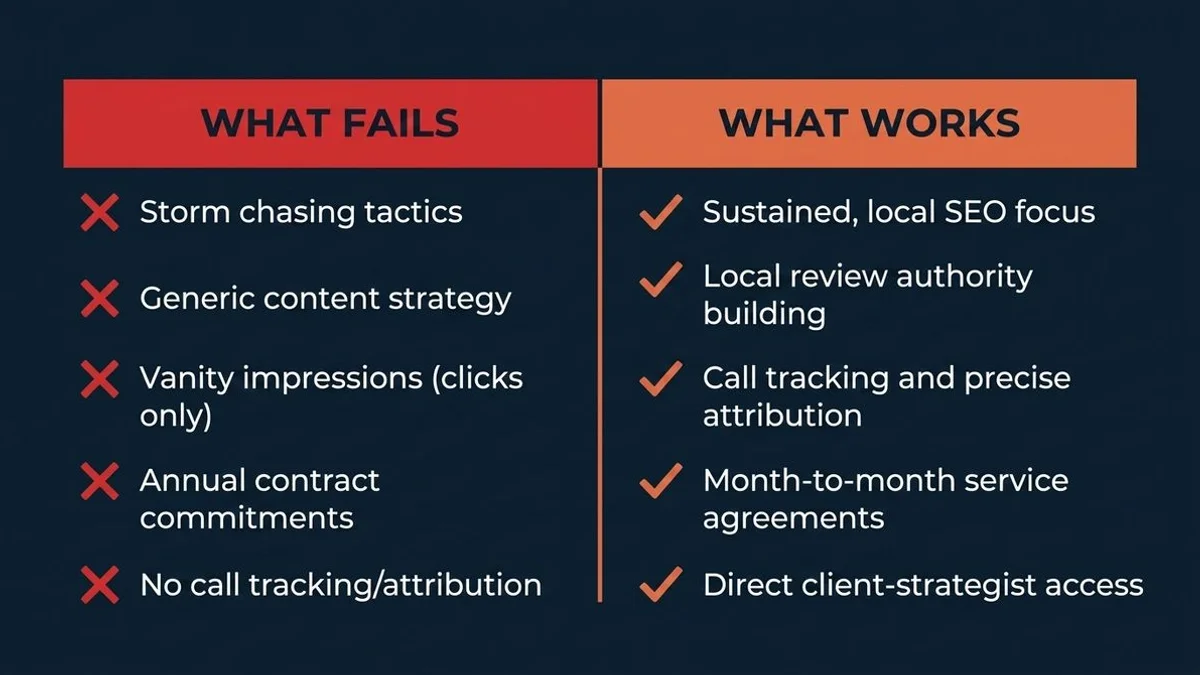
What exactly causes these campaigns to fall flat? They fail because marketers chase storms blindly, ignore call attribution, write generic content, skip review automation, and provide useless reports.
We see contractors lose thousands of dollars each month to these exact roofer marketing problems. This happens when your digital partner lacks industry-specific expertise.
1. The Storm-Chasing Mindset
Many agencies only think about storm-window marketing. They spin up temporary campaigns after a major hailstorm and shut them down 60 days later.
This strategy prevents any sustained local authority from being built. You miss out on the long-game compounding effects of consistent organic growth.
We always remind business owners that starting from zero every spring is a recipe for volatile cash flow. A localized SEO strategy needs a full year to mature and capture steady repair work.
2. Missing Call Tracking Data
Reporting on basic form fills without channel attribution is a massive red flag. You need to know exactly which booked jobs came from SEO, Local Services Ads, or direct referrals.
Without this data, you cannot optimize your marketing budget effectively. We rely on dedicated software like CallRail to bridge this gap.
CallRail’s 2026 data shows that roughly 30% of calls to home service businesses go unanswered. Every missed call is a wasted lead that you already paid for.
3. Generic Content Without Roofing Depth
Generalist copywriters do not understand the details of insurance claim flows or hail damage inspections. They also fail to grasp the specific warranty requirements of major brands like GAF, CertainTeed, and Owens Corning.
This lack of depth means the content reads like it belongs to any generic contractor. Consequently, the website will never rank for buyer-intent search terms.
We use specialized writers who actually understand the trades. General fluff simply does not convert a cautious buyer into a booked appointment.
4. Ignoring Review Generation Systems
Reviews are the single biggest local ranking signal for roofing contractors. Agencies that fail to install automated review request systems leave your most powerful asset neglected.
The 2026 Whitespark Local Search Ranking Factors report confirms this reality. Whitespark data shows that consistent, high-quality Google Business Profile reviews heavily dictate your placement in the Map Pack.
We recommend treating review generation as a daily operational requirement. An automated text message sent immediately after a roof inspection dramatically increases your review count.
5. Vague and Useless Reporting
Monthly dashboards that only highlight a generic “SEO score” do not tie back to your actual booked jobs. Seeing a metric like “traffic is up 18%” provides zero context for whether that traffic produced revenue.
Reports should be designed to be useful for making business decisions. A dashboard is worthless if it only looks impressive on a screen.
The average roofing cost per lead in the US sits around $228 according to 2026 LocaliQ benchmarks. You need to know exactly how many of those expensive leads actually signed a contract.
What Real Roofing Marketing Produces
What should a professional marketing campaign actually deliver? It must produce verified local rankings, clear channel attribution, and a precise cost to acquire a customer.
The accountability standard for this industry is identical to any other home service business. You must demand weekly verified rank maps and precise call tracking with clear channel attribution.
Anything less than this level of detail is just guessing with your budget. We structure our client updates around a very specific reporting cadence:
- Weekly Updates: You need verified rank maps showing your position for primary search terms across your specific service area. This includes a call tracking summary showing the exact call volume and channel breakdown for that week.
- Monthly Reviews: Your report must detail the booked-job count, the specific channel attribution per booked job, and the exact cost-per-booked-job by channel. It should also include recommendations for budget reallocation and year-over-year comparisons if that data exists.
If you do not receive weekly rank maps from your current digital partner, you are missing out on real accountability.
We constantly see businesses flying blind because they accept incomplete data. It is time to expect more from the people managing your advertising spend.
The Booked-Job Standard
How much should you pay to acquire a signed contract? Your cost-per-booked-job should dictate your entire financial strategy.
Cost-per-booked-job, or CPJ, is the single controlling metric for a profitable roofing business. Recent 2026 data from Axis AI shows that the average cost per lead for US roofing search ads is around $187.79.
A high lead cost is perfectly fine if your sales team maintains a solid 25% close rate. For a typical competitive US market, fair CPJ targets look like this:
| Job Type | Target Cost-Per-Booked-Job | Context |
|---|---|---|
| Repair Jobs | $200 - $400 | Shorter sales cycle, highly competitive |
| Replacement Jobs | $400 - $800 | High ticket value justifies the steeper acquisition cost |
| Storm-Claim Work | $300 - $600 | Insurance revenue offsets the slightly higher lead cost |
If your marketing consistently produces a CPJ above these ranges, something is fundamentally broken. The channel mix might be wrong, or your geographic targeting is simply too loose.
We frequently audit accounts where the entire ad spend is being wasted on the wrong type of work. Identifying these leaks early saves thousands of dollars over a single quarter.
Adjusting your bids based on these target numbers ensures your profit margins stay healthy.
What Produces Booked Jobs
What specific tools actually generate signed contracts? A fully stacked approach combining search optimization, paid ads, and immediate follow-up automation is the proven answer.
You need a coordinated system rather than isolated tactics. The full stack includes sustained SEO authority that compounds over a 12-month period alongside weekly Google Business Profile optimization.
We use Local Services Ads to secure the Google Guaranteed badge for our clients. Getting this badge requires passing a background check and providing proof of a $500K to $1M general liability insurance policy.
Immediate Visibility Tactics
Google Ads handle the peak surges during a busy storm season. Local Services Ads sit directly above the standard Map Pack to capture high-intent searches.
Each piece of this digital ecosystem reinforces the others perfectly. SEO produces the sustained organic visibility needed for long-term stability.
Meanwhile, active Google Business Profile management wins the coveted Map Pack placements. This dual approach ensures you dominate the first page of search results.
Plugging the Leaks with Automation
Capturing the demand is only half the battle. Missed-call text-back automation ensures that urgent emergency calls do not go cold.
Industry data reveals that a staggering number of home service calls happen after 5 PM or while crews are busy on a roof. Automation instantly captures the large percentage of inbound calls that every typical contractor misses.
Call tracking then attributes every single booked job directly to the channel that produced it. This data ensures your advertising spend tunes itself automatically over time.
Our roofing marketing builds this exact stack as a fully coordinated 12-month campaign.
A strict reporting standard of weekly rank maps combined with monthly CPJ tracking keeps everyone aligned on actual revenue growth.
How to Vet a Roofing Marketing Agency
How do you separate the experts from the amateurs? You must ask specific questions about rank maps, job tracking, and asset ownership.
Three direct questions will easily cut through most sales pitches:
- “Show me weekly rank-map reports from three roofing clients.” If the sales representative cannot produce them, they simply do not track real local visibility data.
- “What’s your average client’s cost-per-booked-job and how do you measure it?” They should have a specific financial range and a clear software process. Hearing a phrase like “we track form fills” is a warning sign.
- “What happens if I cancel, what do I keep?” You must retain full ownership of your website, advertising accounts, and all related work products.
We always require that contractors serve as the primary administrators on their Google Analytics and Google Ads accounts. Anything less than full administrative ownership means your business is being held hostage.
Want a free roofing marketing agency review and audit? You can easily book a strategy call to get started today. We review your current metrics to uncover immediate opportunities for growth.
Stop guessing and start tracking.